






The Rise of “DefenseTech”: Europe’s New Innovation Frontier
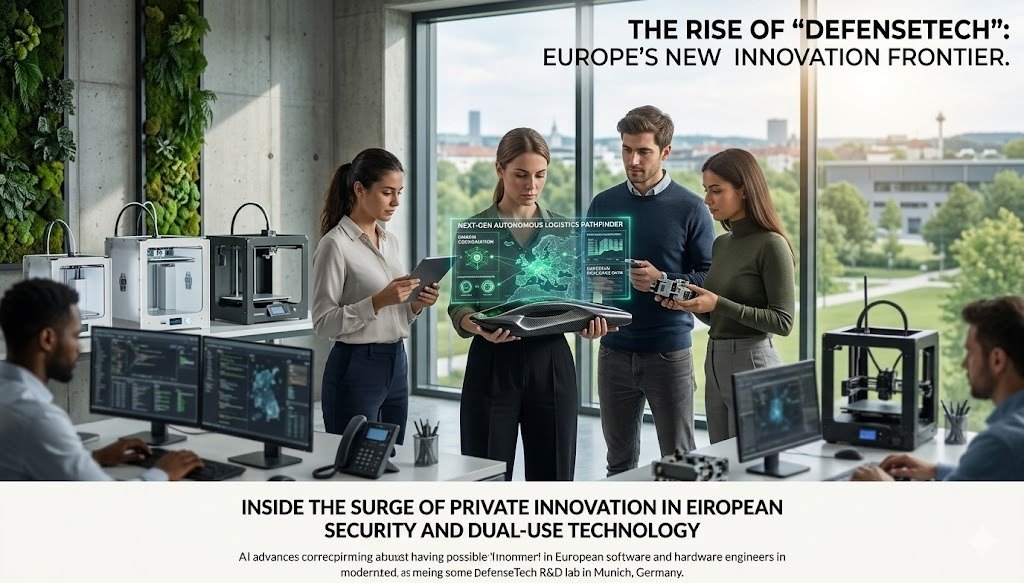
Inside the surge of private innovation in security and dual-use technology.
For decades, the European tech scene viewed “Defense” as a closed-off, bureaucratic sector dominated by giants like BAE Systems or Airbus. However, the geopolitical shifts of the mid-2020s have birthed a new breed of startup: DefenseTech. In 2026, this sector has become the most well-funded niche in European VC, with a record $8.7 billion raised in the last year alone.
The “Dual-Use” Advantage
The most successful European DefenseTech startups aren’t just building weapons; they are mastering Dual-Use Technology. This refers to innovations that serve both civilian and military purposes. For example, Paris-based Harmattan AI recently secured €200M to scale autonomous systems that can manage both battlefield logistics and civilian disaster relief.
The NATO Innovation Fund has become a primary catalyst, encouraging founders in Munich, Tallinn, and Warsaw to apply their skills in AI, robotics, and cybersecurity to the continent’s security architecture. This isn’t just about “war-tech”—it’s about “resilience-tech,” including satellite-based environmental monitoring and quantum-encrypted communication networks.
Breaking the “Old Guard” Monopoly
The true story of 2026 is how small, agile startups are winning contracts over legacy “primes.” By using off-the-shelf components and rapid software iteration, these founders are delivering capabilities in months that used to take decades. For the European entrepreneur, DefenseTech is no longer a moral gray area—it is a mission-critical contribution to “Strategic Autonomy.”